
By Jackson Ngari
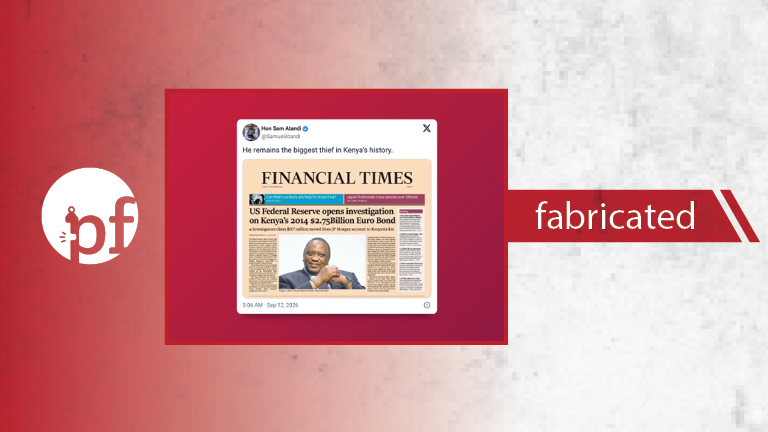
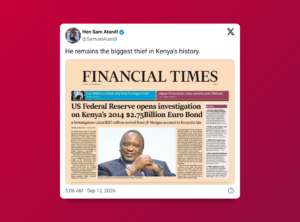
A post on X (formerly Twitter) shared by Alego Usonga, Member of Parliament and Budget & Appropriations Committee Chairman Sam Atandi, displays a front-page graphic from the Financial Times. The headline reads: “US Federal Reserve opens investigation on Kenya’s 2014 $2.75Billion Euro Bond,” accompanied by a subheadline that reads, “Investigators claim $117 million moved from JP Morgan account to Kenyatta kin” alongside a photo of former President Uhuru Kenyatta. Sharing the graphic on September 12, 2026, the lawmaker captioned it: “He remains the biggest thief in Kenya’s history.”
The post had previously circulated across social media platforms, particularly Facebook, where it sparked renewed debate over the management of Kenya’s 2014 Eurobond and had been posted here and here.
Background
Kenya issued its inaugural $2 billion Eurobond in June 2014 under former President Uhuru Kenyatta’s administration to fund infrastructure projects and repay existing loans. Management and expenditure of the Eurobond proceeds have historically been subjects of public scrutiny and political debate in Kenya.
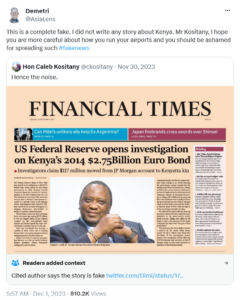
The doctored Financial Times graphic is not new; it first gained traction in late November 2023 when political figures, including Kenya Airports Authority (KAA) Chairman Caleb Kositany, shared it on social media platforms. Disinformation networks frequently recycle fabricated front pages of international legacy publications, such as the Financial Times, The New York Times, or BBC, to lend an air of global credibility to political fabrications.
Verification
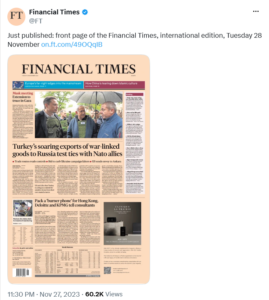
A reverse image search and archive check of the Financial Times print edition from late November 2023 confirm that the outlet never published this front page or headline. The authentic front page of the Financial Times for that period carried unrelated lead stories, including coverage of global geopolitics and the Israel-Hamas conflict, with the lead headline: “Musk meeting extension to truce in Gaza”.
Furthermore, the fabricated graphic attributes the byline to Demetri Sevastopulo, the US-China correspondent for the Financial Times. When the graphic first circulated, Sevastopulo publicly debunked it via his verified X account, stating: “This is a complete fake. I did not write any story about Kenya.”
Additionally, international news agency Reuters previously fact-checked this exact graphic, confirming with the Financial Times and relevant authorities that no such report or Federal Reserve investigation exists.
Verdict
The image purporting to show a Financial Times front page report on a US Federal Reserve investigation into Kenya’s 2014 Eurobond is FABRICATED.


Add comment