
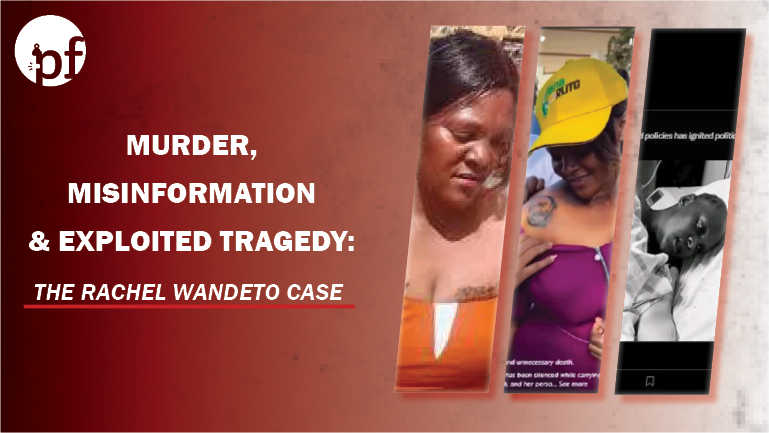
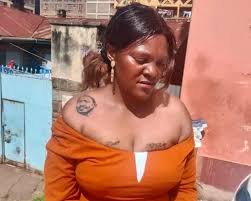
On May 18, 2026, gospel singer Rachel Wandeto died at Kenyatta National Hospital after suffering 75% burns in a brutal attack in Nairobi’s Mwiki area on May 15, 2026. According to police reports and witness accounts, three unidentified assailants accosted her, doused her with a flammable liquid, and set her on fire before fleeing the scene. She was initially rushed to Uzima Uhai Hospital, then transferred to Kenyatta National Hospital, where she succumbed to her injuries. She was buried on Friday, June 12, 2026, at her family’s home in Kabumbu Village, Kirinyaga Central Constituency, after a court ruling resolved a dispute over burial arrangements
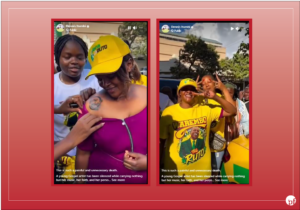
The Kenyan gospel singer gained national attention for tattooing the image of President William Ruto on her right upper shoulder and the slogan “Two Terms” (or “TUTAM”) on her chest, expressing political support for the President. This allegedly led to breaking her marriage.
A Facebook video shared by the head of Presidential Special Projects & Creative Economy, Dennis Itumbi, features YouTuber 2mbili with Wandeto insisting that she would never get rid of the tattoo. She maintained that no amount of money could persuade her to abandon her loyalty to the President. Ruto’s support team, Warembo na Ruto, received her into the team and gifted her branded merchandise, including caps and T-shirts. The Vijana na Ruto team leader promised her shopping, stating that her tattoo had opened her doors to greatness.
Days after her murder, Rachel Wandeto’s death became the subject of claims linking the attack to her political tattoos supporting President William Ruto’s re-election bid in the 2027 General Election.
A NARRATIVE ROOTED IN RECENT EVENTS.
On May 18, 2026, Maureen Matsili, a single mother of four from Gatwikira in Kibera, was allegedly burned with boiling beans by someone known to her following a political argument over her vocal support for President William Ruto’s re-election campaign. The incident began after Matsili repeatedly chanted the “tutam” slogan and escalated when the suspect grabbed a pot of hot beans from a nearby food vendor and poured it onto her, leaving her with severe, life-threatening burns stretching from her chest down to her thighs and private parts. Matsili was rushed to Kenyatta National Hospital, where she remains admitted for emergency treatment. Her family at Kibra Police Station has demanded justice as detectives investigate the assault as a suspected hate crime.
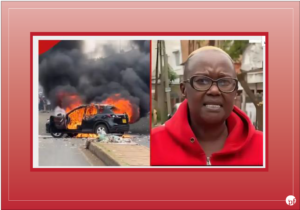
On the same day as Maureen Matsili’s attack during the violent anti-fuel hike protests in Githurai 45, Kiambu County, Priscilla Njiraini lost her black Mazda CX-5 when it was torched by furious protesters who discovered a UDA sash inside the vehicle. The car owner, who is a Kiambu MCA aspirant running in the 2027 polls under UDA, was driving her husband, Henry Larweh-Martey, to buy construction materials in Kamakis when the crowd, already agitated by fuel price fury, became enraged upon finding UDA campaign materials. They pulled the driver to safety before torching the car. On June 2, 2026, DCI arrested Elisha Karanja Gatwa in Ruiru as the suspect was captured on camera burning the vehicle, while the driver narrowly escaped to safety. The two incidents happened amid growing concerns about politically motivated violence targeting Ruto administration supporters.
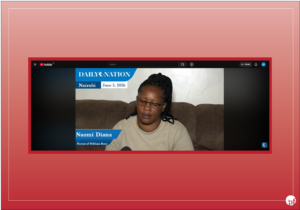
A young boy in Nairobi is facing severe bullying and discrimination at his school simply because of his name, William Ruto. Naomi Diana, the boy’s mother, named him in 2022 in honor of President William Ruto after he won the elections. However, the PP2 (Pre-Primary 2) student has become a target of ridicule, with fellow pupils cornering him during break sessions and rec assembly, chanting “Ruto Must Go” and “Wantam”, leaving the boy distressed and reluctant to attend school. The mother has expressed deep anguish, saying her son has begged to either change his name or switch schools, but she refuses to change the name because she loves and supports President Ruto, stating “I need security for myself and my son. I’m surprised that it’s a crime to name your child Ruto. I cannot change the name because I love Ruto,” she stated.
On May 21, 2026, President Ruto mourned Rachel Wandeto in Mombasa, claiming she was attacked due to her political stance. The President on Facebook and X condemned political violence. His framing inadvertently validated the false political narrative that investigators had already ruled out.
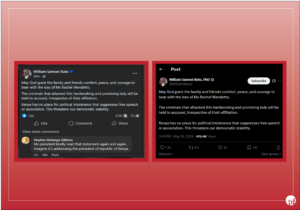
THE INVESTIGATION: BEYOND POLITICS
Piga Firimbi’s investigation reveals a stark information asymmetry: while the Directorate of Criminal Investigations (DCI) ruled out political motives and arrested a suspect linked to financial disputes and personal conflicts, social media amplification networks pushed a false “political martyrdom” narrative at a ratio of 62:1 against factual corrections.
On May 21, 2026, Chief Inspector Raphael Wanjohi presented evidence to Makadara Law Courts showing that Josiah Njeru Njiru was the last person to communicate with Wandeto before the attack. His mobile phone location data placed him near the victim’s residence on the night of the attack, despite not being a resident of that area. The 36-year-old taxi driver had frequently visited the victim’s neighborhood over the three months preceding the attack. Investigators were examining CCTV footage, call data records, financial transactions, and biological exhibits, including DNA samples.
The DCI requested a 21-day detention period, but Resident Magistrate James Juma Mayiah granted a 10-day detention at Kilimani Police Station, with the case scheduled for mention on June 2, 2026. Critically, they indicated the probe was exploring money disputes, personal conflicts, and a possible love triangle, not the victim’s political tattoo. According to multiple credible reports, the attackers had demanded money they believed Wandeto had received for her political support, suggesting the motive was financial rather than ideological.
On May 18, 2026, Interior Cabinet Secretary Kipchumba Murkomen directed the Directorate of Criminal Investigations, IG Kanja, to speedily investigate the motives behind the barbaric act to ensure swift justice for the family. “It should get into the conscience of those propagating politics of hate, violence, and division. When I visited Rachel in the hospital last evening, her face showed resilience and courage. It is quite unfortunate that she lost the fight,” Murkomen said.
Within days, Rachel’s death became the centerpiece of a coordinated campaign, generating over 1,200 social media posts and reaching an estimated 123 million people with false narratives.
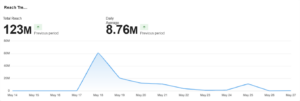
The gap between investigation reality and public perception represents a case study in narrative hijacking, where coordinated amplification, timing manipulation, and selective outrage transformed a criminal investigation into political theater.
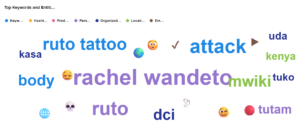
C.S Murkomen and President Ruto’s linking of Wandeto’s death to political intolerance without acknowledging the DCI’s findings triggered 72.8% of all social media activity, demonstrating how high-level political statements can inadvertently fuel misinformation ecosystems.
Democratic governance rests upon the foundation of equitable representation, demanding robust protection for diverse perspectives and political discourse. When tragic events are deliberately manipulated to advance partisan objectives, the very bedrock of democratic principles suffers erosion. As Kenya approaches the 2027 General elections, the imperative to identify and neutralize coordinated disinformation operations intensifies.
THE COORDINATED INAUTHENTIC BEHAVIOR CAMPAIGN
Piga Firimbi analysed 1,208 Twitter/X posts from 948 unique accounts between May 16-25, 2026, the critical 10- day window surrounding Rachel Wandeto’s death. Our analysis reveals a disturbing pattern of misinformation that drowned out the facts.
A staggering 86.9% of all posts (1,050 out of 1,208) were reposts/retweets, not original content. This extraordinarily high repost ratio is a classic indicator of coordinated amplification campaigns, where a small number of accounts create content and a large network of amplifiers boost it.
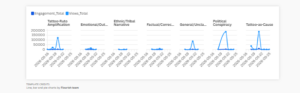
Flourish showing narratives against engagement and views total
TIMING PATTERN: MANUFACTURED VIRALITY
Analysis of social media activity surrounding Wandeto’s death reveals a suspicious pattern inconsistent with organic information spread:
• May 18 (Day of Death): 107 posts, mostly media reports, with some already framing the tattoo angle
• May 19-20 (DCI Investigation & Arrest): Only 155 posts corrected the information, gaining traction despite major investigative developments
• May 21 (Presidential Speech): 880 posts in a single day (72.8% of all activity), explosion of amplification following President Ruto’s Mombasa speech
• May 22-25 (Post-Peak): Activity dropped to 62 posts, but the false narrative was already entrenched
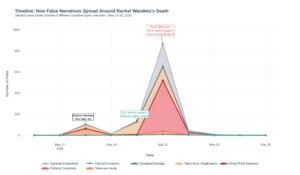
This pattern, a massive spike of coordinated amplification AFTER factual information was publicly available, is a hallmark of manufactured virality. The DCI’s arrest of a suspect and indication of non-political motives were public knowledge before the largest wave of false narratives hit social media.
THE INFORMATION ASYMMETRY: 62:1 AGAINST TRUTH: FACTS VS FICTION
Perhaps the most alarming finding from data analysis of the social media ecosystem is the massive gap between false narratives and factual corrections:
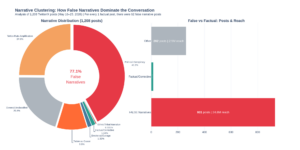
• False narratives: 931 posts (77.1% of total volume) with combined reach exceeding 25.7 million
• Factual corrections: Only 15 posts (1.2% of total volume) with a reach of approximately 1.26 million
• Ratio: For every 1 factual post, there were 62 posts promoting false narratives.
• The “tattoo-as-cause” narrative alone (116 posts) reached an estimated 17.6 million people (14 times more than all corrective posts combined)
This information asymmetry was not accidental. It resulted from:
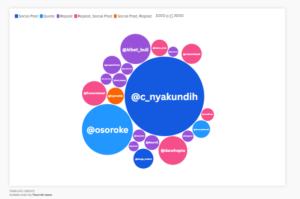
1. Amplification Networks: Coordinated sharing from accounts with large followings, particularly @C_NyaKundiH (has an audience of 1.1 million followers on X and is recognized by the Reuters Institute as a prominent news creator in Kenya) and @georgediano, (a vocal social media personality and government critic with 198.7K followers on X), which triggered cascading reposts.
2. Emotional Framing: False narratives were packaged with outrage and moral urgency, while factual corrections were presented in neutral, procedural language
3. Political Validation: High-level political statements lent credibility to the political narrative, making corrections appear partisan rather than factual
4. Algorithmic Amplification: Emotionally charged content received preferential treatment from social media algorithms, compounding reach disparities
The result: millions of Kenyans formed their understanding of Rachel Wandeto’s death based on false information that investigators had already debunked.
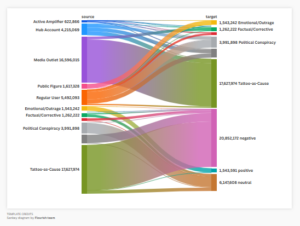
The “Tattoo-Ruto amplification” narrative was boosted by 301 posts (24.9%) that didn’t explicitly make false claims but reinforced the misleading framing. These posts perpetuated the debunked “tattoo motive” story long after the DCI dismissed it.
NARRATIVE 2 : “KILLED BECAUSE OF A TATTOO”
The narrative Rachel Wandeto was specifically targeted and killed because President Ruto’s tattoo had 116 posts with a combined reach of over 17.6 million. This narrative was pushed by major media outlets and influencers before police investigations were completed. Captions like Citizens TV’s “Artist attacked over President Ruto tattoo dispute” and “Killed for having a tattoo of the president” went viral within hours of her death
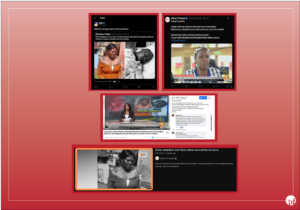
Screengrab of narratives spread of Rachel Wandeto Killed because of a Tattoo
NARRATIVE 3 : POLITICAL CONSPIRACY THEORIES
The political conspiracy theory was amplified by 644 reposts (53% of all repost activity). Their single most viral post by @C_NyaKundiH about Ruto’s “propaganda” regarding the tattoo narrative , achieved 1.1 million reach, 175,638 views, and 8,315 engagements. This account single-handedly drove the political conspiracy narrative.
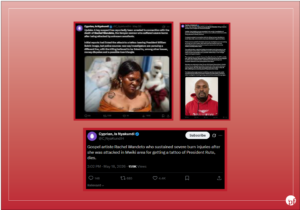
Cyprian Nyakundi’s posts reporting on Rachel Wandeto’s case
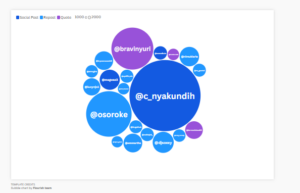
Top accounts that spread political conspiracy
NARRATIVE 4 : ETHNIC/ TRIBAL EXPLOITATION
The largest category of false narratives (510 posts, 42.2% of all content) turned Rachel’s death into a political weapon. Multiple competing conspiracy theories emerged:
– Accusations that President Ruto pointed the finger at former Deputy President Gachagua for orchestrating Rachel’s murder.
– Assertions that the UDA party disseminated “propaganda” by weaponizing the tattoo story for strategic political gain.
– Claims connecting Rachel’s passing to a wider climate of “political violence” supposedly triggered by Ruto’s administration and its policies.
– Allegations that state authorities were intentionally exploiting the tragedy to manufacture false charges against political rivals.
A smaller but dangerous narrative emerged claiming “MT Kenya Leaders Curse Kikuyus who Killed Rachel Wandeto Over a Ruto Tattoo”, framing the incident along ethnic lines and inciting inter-community tensions. This narrative, pushed by accounts like MutembeiTV, was particularly irresponsible given Kenya’s history of ethnic violence around political events.
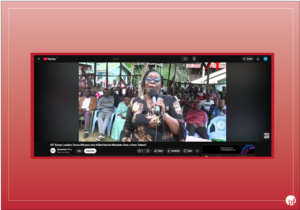
Mutembei TV’s narrative pushing ethnic / tribal exploitation.
NARRATIVE 5: FACTUAL NARRATIVES
A KTN news report confirmed the family’s position that the “true circumstances surrounding her death remain unknown until the outcome of the investigation.” The family of Rachel Wandeto is calling on investigators to fast-track their probe and ensure those responsible are held accountable.
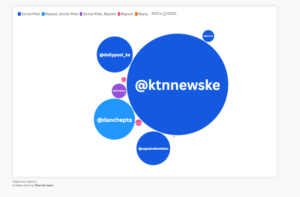
Top actors involved in factual narratives
Who Benefits from the False Narratives?
The discourse surrounding the killing illustrates how online actors exploited the tragedy to deepen public divisions. Some framed the incident as evidence of persecution against President Ruto’s supporters, with claims such as “Artist attacked over President Ruto tattoo dispute” and “Killed for having a tattoo of the president.” Others used the case to accuse the administration of political opportunism, particularly in relation to President Ruto and Interior Cabinet Secretary Murkomen remarks after DCI findings. As the story gained traction, it was increasingly weaponized to target Gachagua, inflame ethnic tensions, and drive engagement through sensational and polarizing content.
In every case, Rachel Wandeto, the actual victim, was reduced to a political prop. Her real story, her family’s grief, and the actual circumstances of her attack were buried under layers of political exploitation.
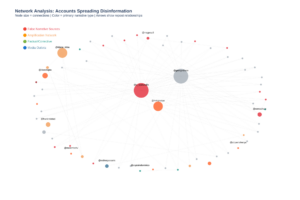
Network analysis diagram of accounts spreading disinformation
Analysis: How Narratives Overtake Facts
The Rachel Wandeto case demonstrates several critical vulnerabilities in Kenya’s information ecosystem:
1. The Speed Gap: False narratives spread at viral velocity while investigative facts emerge at institutional pace. By the time the DCI arrested a suspect and identified non-political motives, the political narrative had already achieved saturation.
2. The Authority Paradox: When high-level political figures validate a narrative, even inadvertently, it becomes exponentially harder to correct. President Ruto’s condemnation of political violence, while well-intentioned, gave credibility to a motive that investigators were ruling out.
3. The Emotional Premium: Social media algorithms prioritize engagement, which favors emotionally charged content over factual accuracy. “Gospel singer murdered for supporting the President” generates more engagement than “Suspect arrested in connection with financial dispute.”
4. The Correction Deficit: Fact-checks and corrections receive a fraction of the reach of original false claims. The 62:1 disparity observed in this case is not an anomaly, it’s a structural feature of social media information dynamics.
5. The Narrative Cascade: Once a false narrative achieves critical mass, it becomes self-reinforcing. Subsequent events are interpreted through the lens of the established narrative, regardless of contradictory evidence.
Limitations should be noted: the dataset reflects a filtered collection, not a full platform capture. Account creation dates, follower counts, and verification status were unavailable, constraining the ability to identify newly created or bot-like accounts with certainty.
Follow Africa Uncensored’s WhatsApp Channel for verified facts and updates on what’s happening online.


Add comment